Sunday, June 10, 2012

Vital Components of a Comprehensive Trading Plan

Illustration: Analyze 

You must have heard several times that it is important to have a trading plan and stick to it. Not having a trading plan is like an invitation for failure as a trader. What is meant by building a trading plan? Here are some broad points to consider.
The Importance of a Trading Plan
Trading plan is nothing but a checklist. You refer to it before taking a trade. When in a trade you refer to it to make sure that you take a decision according to a plan. Checklist also helps you to stay away from trades which are low probability set ups. The whole idea behind the trading plan is to keep emotions away and take decisions logically.

Stay Away from Bad Trades
The first aspect of the plan should be an affirmation to take only those set ups which are in accordance to your trading strategy and that you will not indulge in overtrading or revenge trading. This will allow you to stay away from bad set ups. If you are a price action trader and take only daily or weekly set ups, you can read the affirmation daily till it becomes your second nature not to look at lower time frame and study only daily and weekly charts.
Write Realistic Expectation
The next part of the plan is to devise a realistic expectation from your trading. It could be in monetary terms like earning so and so dollars each month. Don’t expect to earn thousands of dollars right from the start. Here’s an excellent example of trading with realistic expectation: double your account with 4 trades per month.
A Concrete Trading Strategy
Now we have come to the core of the trading plan which is formulating a trading strategy. After demo trading for a few months will let you know which trading strategies suit you better and which trading strategies you are good at. Knowing is not enough. You should customize your trading strategy to suit your needs. It will not be the same strategy for a trader with a million dollar capital and one with few thousands dollars of trading capital.
Incorporate Aspects of Risk Management
A special attention should be given to money and risk management. Depending on the initial capital, you should determine what the acceptable risk is for you on each trade. You should create a template in excel which will give you the trade size. Also once in a trade, you should keep assessing the progress of a trade. The factors to be assessed should be clearly mentioned in a trading plan. It typically involves the profit targets, when to book a loss if trade goes against you etc. This will help you in better management of the trade.
Your Location Plays a Role
Forex trading is different from stock trading. Everyday different events happen that affect the currency market. You as a trader should keep an eye on these events and decide when to be in the market and when you should stay away from the markets. Also different aspects have to be considered depending upon your location in the world. It may not be possible for you to trade every single currency 24 hours a day. Your trading capital can also play a role here. It may not be possible for every trader to trade certain instruments because of the margin requirement and risk involved.
Having a written trading plan will be of immense help. It will keep a tab on you to make a logical decision. If you don’t have a trading plan, build one for you right away.

Mari Belajar Fibonacci

Illustration: Analyze 

The Fibonacci retracement tool is one of those tools in forex that a forex trader simply cannot do without. This is because in the financial markets, prices do not move in a continuous straight line, but in a convoluted twist of pullbacks and advances. Whenever the price action of a currency has moved substantially in a particular direction due to a very strong trend, those traders who were able to get in early would at some point, decide to take some profits from their trades. This will place the gaining currency on offer and will lead to a supply excess over demand for that currency at that particular time, leading to price pullbacks.

A dilemma has always been how to determine with some degree of accuracy, how far the price action of the currency will pull back before resuming the move in the direction of the previous trend. This renewed move in the previous trend occurs because traders now perceive the currency in question to be at bargain levels, low enough to be able to still grind out some advance movement for profit.
This is where the Fibonacci retracement calculator comes into play. Traders can use it to identify the possible levels to which prices will pull back, and there are five levels to choose from.
In this piece, we will deal with how to correctly apply the Fibonacci retracement tool to a forex chart, as this is one area where traders make mistakes when using the Fibo tools.
Step 1
The first step is to open an appropriate time frame chart. The Fibo tool is used to detect levels at which trend retracements will end. Trends can only be correctly determined from longer term charts such as the daily chart. So you can open a daily chart as the first step.
Step 2
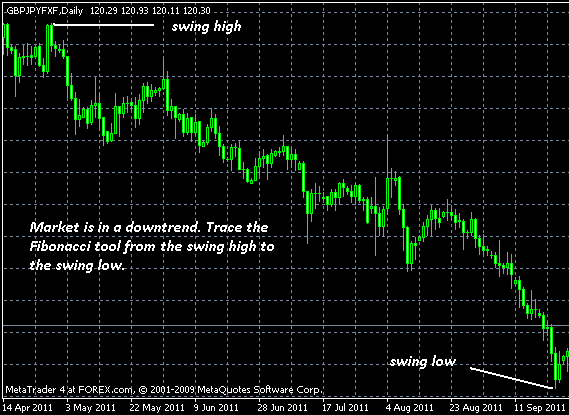
Identify the swing high and the swing low for the forex chart. The swing high is the highest point the price action has reached for the time period in view. The reverse is also true for the swing low.
Step 2.1
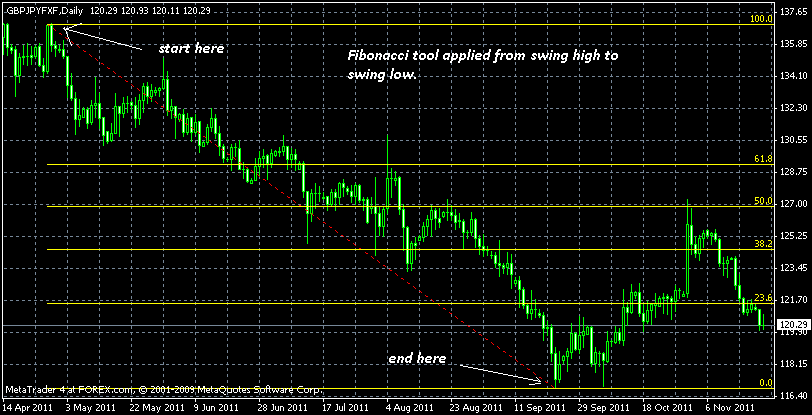
Select your Fibo tool, and if the market is in an uptrend, apply it to the swing low and trace the tool to the swing high. If the market is in a downtrend, apply the Fibonacci retracement tool from the swing high to the swing low.
Step 2.2
Step 3
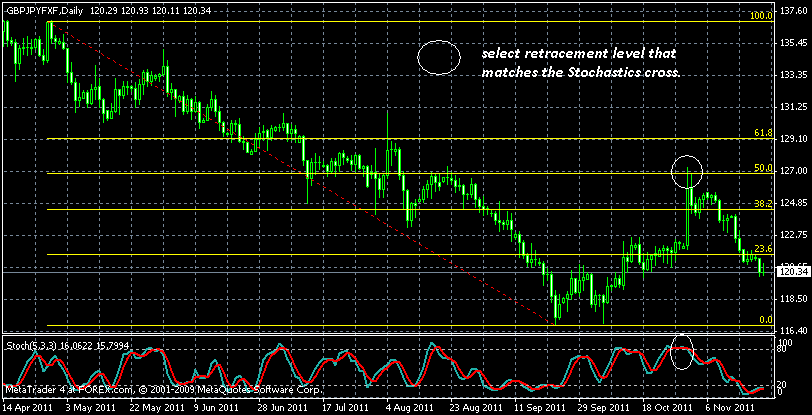
Apply a supporting technical indicator to the chart. The Stochastics oscillator, which detects overbought and oversold conditions and hence is perfect for detecting reversals, works very well here. Select the retracement level where the Stochastics cross at the oversold region for an uptrend (with downward retracement) or at the overbought region for a downtrend (with an upward retracement).
Step 3
Once you get the appropriate retracement level, it is time to take your trade in the direction of the main trend.
After reading this piece, you should be able to plot your Fibonacci retracement tool correctly so you can detect the appropriate level at which the retracement ends and a new round of buying begins.
Furthermore, do you need some extra Forex tools as a free trend detector? If so, click here for downloading free Forex tools from Pipburner. Respect the author and spread the word!

What You Should Be Doing When You Hit A Losing Streak Day Trading

Illustration: Money 

If you have traded the markets for any length of time you know that markets can and will change every so often. The problem with most trading systems is that they are designed for one type of market condition and that is it. As soon as conditions change, you are left with a system that under-performs. The great part about the NetPicks systems is that they are very flexible and can be adjusted to fit different market conditions. The Seven Summits Trader indicators give us access to so many different inputs that we can fine-tune our system should markets change. This gives us an incredible amount of power with our trading.

However, even with a dynamic system like the SST there will be times when we do need to make adjustments. For example, equity markets made a big change during the 4th quarter of 2011. We went from seeing nice movement to wild swings back and forth in both directions. This made it very difficult for my swing trading over the last few months of 2011. The good news is that I’m using the SST system, which gives me an edge over time. It is very important to trust this edge and to not over react to dips in performance over the short term.
The key to using such a dynamic system like the SST is to be very patient with change. Once you hit that first losing streak, it is going to be very tempting to want to throw everything out the window and start fresh with new settings or a new system all together. However, you need to make sure you are letting the edge that the system gives you play out over time. Even if you are winning 65% of the time that means the system is still losing 35% of the time. If you quit after a few losers you are going to miss out on tremendous profits in the end.
This is exactly why I like to track my performance on a daily basis. I take time everyday to log my trades and to take notes about that days performance. That way I know over time how my system is doing. Once you hit those few losing trades you can go and see that even with those losers the system is still very profitable over a larger sample of trades. This can help with the emotional aspect of trading. We have all been in that place where you get frustrated with the lack of profits. By having a trade journal you can go back and review the big picture.
When you do reach that point when it is time to make changes, what steps do you need to follow? Here are a few thoughts to keep in mind:
  • Make sure you are following all the rules of your system and trade plan correctly. If you are in a losing streak is it the system breaking down? Or is it just you making mistakes? I’ve been on both sides of this one myself over the years.
  • Review your trade journal to see an extended performance report. If you don’t document your trades on a daily basis, go back and record a few months worth. This way you can determine if it is a market change or just a pullback in performance.
  • Are there any small changes to your trade plan that you could make to help performance? For example, a change in start/end time or trading a different time of day. This will be much easier than starting over with a new market or even a new system.
  • Be slow to change. Your system won’t be profitable every day, week, or even month. If it is a proven system then give it time to get through a slow down. Many retail traders spend years and thousands of dollars going from one system to the next when all they need to do is master one system for the long haul.
  • If you do make changes to your system and trade plan make sure they are backed up by results and not just a hunch. We all tend to think we are smarter than we really are. Let the numbers speak for themselves. If you have an idea of a change that might improve performance, you better be able to back that up with test results.
Finally, make sure you are a consistent trader. This means you are taking the time to test your system before jumping in with both feet. Once you are trading live, make sure you keeping a daily trade journal. I know it is not fun stuff to do but it will pay off in a big way once you hit that first slowdown. Instead of beating your head against a wall trying to figure out what to do you will be able to calmly react accordingly based on numbers and a real performance report. The best traders I know are the ones that stay disciplined and committed to trading their system correctly over time. Always looking for the next best market or system will only lead to frustration and a loss of thousands of dollars.

Dealing with Your Forex Losses

Illustration: Currency


There’s no denying that forex trading is an exciting way to make money. You can get a return on your investment in a matter of minutes if the market goes your way. It is inevitable however, that you will take some losses, but if managed correctly they can form part of a successful strategy. Here, we will look at different methods for dealing with losses.

Control Your Emotions
Lack of emotional control and mental discipline is the main cause of failure among online traders. Lots of accounts are wiped out early because traders act like scared animals in the highly charged atmosphere of the markets. Many more won’t reach a stage where understanding statistics and economic data can help produce better profits. Controlling your emotions, therefore, is an important part of managing losses.
To successfully trade forex, you need to isolate emotions while dealing with the markets. Markets move by emotions but logic is needed to analyze those movements correctly. You need to step back and look at the bigger picture. Study the figures, plot charts and only move when the time is right. Don’t be tempted to rush in.
Avoid Minor Currencies
Stick to the major currencies when trading forex. Smaller currencies are riskier because they fluctuate more than larger, more stable currencies. Avoid potential losses and trade the American dollar rather than the Norwegian Krone. Remember that smaller currencies will also be more expensive to buy because they are illiquid and are traded in lower volumes.
Trade with a Stop-Loss Limit Order
Trading with a stop-loss order will help prevent large forex losses. This will tell your broker to sell a currency when it reaches a certain price e.g. setting a stop-loss order for 10% below the price you paid for a Euro order will limit your loss to 10%.
Use a Take-Profit Order
Take-profit orders are used by currency traders to lock in profits should the currency move in their favor. It specifies the exact rate or number of pips from their current position to where they can close out for a profit.
Trade with a Plan
Do not rush in. Start by examining charts which will give you more information about the currencies you want to trade. Look at the 5 second, 1 hour, and 1 day charts to understand how a currency might move in a trading session. Technical and fundamental analysis are also worth looking at to help look for possible long-term trends.
Avoid Trading Lots of Pairs
Trading lots of currencies is asking for trouble. You will spend too much time looking at charts and not enough time tracking your investments. Keep it simple and focus on a few pairs. More currencies increases the risk as there’s a chance one will drag all your investments down.
Notice Trends
If you notice a downward trend early on in your trading, cut your losses and get out. Do not continue losing money. A stop-loss order will help in these situations.
Keep Records
It is important to keep a record of losses to be always updated with a currency’s development and avoid any future mistakes. Keep a notebook specifically for forex trading and make a chart with the following titles:
  • Trading date
  • Beginning balance
  • Number of trades
  • Pairs traded
  • Strategies used
  • Ending balance
  • Forex trading losses

7 Mistakes That Forex Traders Make: How to Stop Losing Money


Forex trading is a great way to make good money by leveraging your capital against the small currency movements which happen every day. Unfortunately it can sometimes get a bad name due to all of the systems and courses online which promise to make you rich overnight.
The good news is that you can still make money from trading currencies, but there is a steep learning curve and plenty of mistakes that you will need to avoid. To get you started, here are the worst ones:

Greed
Greed can cause you to forget about the rules you have put in place that might be telling you to get out of a position. Holding on to make sure you get the maximum profit in a profitable trade is important, but getting greedy and holding on too long can lead to sudden losses.
Impatience
If you have a good understanding of the market and your strategy you should be able to pick positions well, but sometimes opportunities just don’t seem to be happening – staying disciplined and patient in these times will prevent you from entering positions which you know you should stay out of. Instead, spend some time reading the news, check a currency converter periodically or just blow off some steam and come back later to see if things pick up.
Chasing Losses
A good currency trader makes more money from the wins that he loses on the losses, but sometimes a string of losses will happen; guaranteed. If you get a string of losses it is easy to lose your head and start taking risks in an attempt to win it all back – if you feel the urge to do this, take a couple of days off, analyse your losing trades and come back prepared to trade better than before.
Lack Of Focus
There are all sorts of different systems out there which tell you wonderful and clever ways to make your Forex trading easy – but it never will be easy. Try to avoid overload on these systems, pick a simple strategy and put in the hard work to fully understand what you are doing, this focus will make you a better trader in the long run.
Looking For Shortcuts
This is kind of similar to the point above, but possibly an even more dangerous mind set. If you are looking for shortcuts you presumably believe there is an easy way to succeed, and until you accept that this isn’t the case, you might as well be gambling.
Fear
Fear isn’t a common problem, but it does happen; if you find a good spot, and all the signals are saying go for it, but you hesitate and enter a position late, you are letting fear chip into your already narrow margins.
Gambling
You probably think that you are not doing this; all Forex gamblers do. Each and every position you close, win or lose, you should be able to justify to yourself exactly why it was the right move. If you ever answer something along the lines of “I just had a feeling” – like it or not, you are gambling.

Friday, June 8, 2012

Trade 08/06/2012


Semalam 7/6/2012 hari yg antara menyeksakan aku, aku menggatal nak buat scalping, dan keputusannya aku :

Win - 2
Loss - 8
Total entry - 10

BAGUSSSSSS

Sedih, kecewa dan marah bila perbuatan bodoh yg aku buat, tapi sekali lagi aku gagal untuk mengawal rasa x puas hati, rasa untuk menebus kekalahan tu masih menebal. SAMPAI BILA aku nak belajar dari kesilapan....... Sepatutnya apabila 3 kali kalah, aku kena terus close MT CHART and get out and do something else . YOU NEVER LEARNNNNN


TAPI

Alhamdulillah, hari ni aku recover balik sikit walau pun x banyak, tapi still recover, syukur pada tuhan acount aku x MC . Disaat aku masuk entry pagi tadi, aku tertidur lena diulit intan berlian, bangun2 jer dah TP. Keje gila lagi.

Win  - 4
Loss - 0
Total Entry - 4
Total pips - 102 pips collect 


 1. AUD / USD
     Win - 28 pips


2. EUR / USD
    Win - 38 pips


  3. EUR / JPY
      Win 28 pips


 4. GBP / USD
     Win 7 pips 
****** cut