Sunday, June 10, 2012

Trade Forex as a Business


So you want to earn lots of money and become amazingly wealthy. You have heard the rumours about Forex trading $3 trillion DAILY, and you figure you want a piece of that, just a little bit as you are not greedy…
So you now go out and buy the latest crazes of an EA, one copies the trades of a real life trader, and the other is the best EA on the market that shows that the creator (who used to work as a bin man, and now codes EA’s and buys the latest sports cars etc) turned a measly $100 to earning $56,637 per month stress free…

So you sit back and watch that investment of yours turn into zero over the course of a matter of days….
You wonder what could have gone wrong? Surely it could not have been your fault… after all, you were not making the trades… it must have been the software… of course it was!
Except what really went wrong, is that you fell for (yet another) marketing ploy.
Forex is a highly complex beast that requires attention, knowledge, experience, emotional control, money and more than anything business acumen.
This may sound strange, because all you are doing is pressing a button to buy or sell… it must be easy to make money?
Look at the flip side. Doctors spend about 10 years learning their trade, and in this time they are spending money on their training. It is not until they qualify that they start earning this money back, and the promise of earning back much more than their investment. Saying that, they still have to work exceptionally hard at it, pulling 24 hour shifts, working 7 days on the trot, working over bank holidays, national holidays, Christmas, New Year… Why would you think that they would do that if Forex was so easy? Surely these highly intelligent people would be far better plying their knowledge on the markets?
The reason is, is that not everyone is cut out for forex trading, and secondly, not everyone has the business mind to become successful… although his can be learned over a period of time.
So how do you make Forex trading a business? How do you treat it like one?
First and foremost, experience is key. Now I would not expect anyone to trade for 10 years before having their first try in a live trading account, but at the very least you should know how Forex works – this is your basic business analysis and market research. The factors that go into a trade, position sizing, money management – these should all be learned and then applied to your strategy.
Once you fully understand this, it is now time to implement your strategy. This could be someone else’s that you are using exactly, one that you have found somewhere else but have adapted to your own style, or one you have come up with yourself. Regardless of where you got your strategy from, you need to test it.
When you test it, it is not a case of testing it for a couple of trades and then diving in to the markets. You need to test for months before you apply it to the market. This could be a demo account or a micro account if you can afford to throw a couple of thousand dollars away. You have to assume that you will lose any money you invest if you are testing a system – you expect the worst and hope for the best. This is purely to see if the system works mechanicly (as in determining your rules). This should be done on the higher time frames – 1 day, 4 hour etc. The reason being is because the higher the time frame, the stronger the move.
You do this for 3 months continually. If you are successful, you can look to trade the smaller timeframes, to test where the system works best.
If you are not profitable, you start again for the 3 months and refine the system.
Rinse and repeat
The reason for this is that you are getting experience, you are doing your market research, you are learning the drivers of your system. On top of this, you are also minimising your losses (having a demo account- you have zero losses) and maximising your learning curve.
Once you are profitable 3 months in a row and you are happy that you have a system that works, you can go to a live trading account, but you need to start small. Micro accounts are for this very purpose. Again you need to be profitable 3 months in a row before you invest more, and move up to a mini account or standard account.
If you change any part of the system, you need to go back to the demo stage.
It may seem overkill, but I can guarantee that any successful business does not take unwarranted risk. Any strategy needs to be thoroughly tested – think of manufacturing here, stress tests are done to ensure the product is robust enough to succeed!
Would you rather spend 10 years perfecting and refining a system that can earn you millions (yes it is possible) or spend 5 minutes blowing your account through lack of knowledge?
Great traders are made over the course of years. No trader has ever made it by pure luck. They know their market inside out, and they adhere to strategies that are proven.
I keep a blog of the strategy I am implementing -www.100percentforex.blogspot.com, and over the course of 2 months I have refined my strategy and have not lost any money due to it being on a demo account. I am still going to demo for another 2 months because I want to succeed.
If you want to invest in Forex, invest in an education first, it will pay dividends at the end.
Have goals in mind, keep journals of all your trades so that you can analyse them. Know when to enter a trade and more important exit a trade. Know your risk, your position size, know the news coming out. The more you know the more you are likely to succeed. Don’t believe the hype surrounding the next big marketing release, they are destined to fail and make you poorer.
Most of all, enjoy your trading! We want to be traders so that we can work for ourselves – why take all the risk if you are not going to enjoy it?
Happy trading!


Make Money by Following Experienced Forex Traders

Illustration: Money 

The Forex Trading Market is a big one. Over 2,5 TRILLION dollars fluctuate this market every day. This is a nice way to get a small piece of a big pie and become very rich in an enormously fast way. That is why so many young traders decide to dive into this market and invest their life savings without digging a lot deeper into the success secrets. This can be very dangerous for any investor. So there are a couple of ways how to insure earnings when you are using Forex Trading system.

The first one is to find some nice resources online to help you by providing a Forex Trading Course, so a professional can guide you through the whole process and tell you all about the “dos” and “don’ts” of this trade. These online Forex Courses offer live help right at the beginning of your individual trading process so you will be able to recognize and avoid dangerous situations. These mentors will guide you till you demonstrate ability to be earning money online on your own safely.
The other way to go is to follow the steps and signals of an experienced trader and just repeated what he/she does (has done) to earn his/her fortune. That is maybe a less safe way but it is a lot faster. So the trouble here is how to find the right Forex Trader to follow. This is just a beginning of the problem.
From the other problems that follow, the first one is the way a system is transferred or copied from this experience trader. What happens usually is that a new trader buys the system from an experienced one, but this system that way that it is bought is not presenting the EXACT way the system worked, so it will not reveal the EXACT steps to earn.
Sometimes a new player in this game buys a book or an electronic book or a proven track record software that presents the same problem again.
What happens is that the Forex Market is a very dynamic one and it has periodical, sometimes even daily, fluctuations that only an experienced trader can track and adjust to make profit. No book or software, no matter how well updated it is, can anticipate the market turns and get the best out of them. It turns out you have to be a good trader with a good sense for this thing to make it work your way.
So how can you win this market? Is there a way to copy an experienced trader exactly and make profit out of your investment? Yes, there is. The first and probably the best way to go is start a course that a professional can guide you through the whole process safely and provide you with advice and guidance once you start the trading yourself. The other way to go is to have an experienced trader SEND you signals in real time. So how many of the good ones are prepared to do this? The answer: is not many. Those few good ones that are willing to provide this service can teach you a lot more than any book or software ever will.
So you can go the safe way or the fast way, anyhow you will need an experienced professional to guide you through Forex Trading.

Why PIPS are Almost Irrelevant for Measuring Forex Trading Performance?


When forex traders or companies want to tell other traders or people who might be interested in their trading about their performance they will often show them the number of pips made in a trade or in a given amount of time. Which is not bad at all but not enough information to say if a trader is consistently profitable. A pip in the forex world is commonly known as a point a currency pair moves either up or down. For example if the EURUSD jumps from 1.3800 to 1.3801 it has moved exactly up by one pip. What most traders or signal services do not publish is how much money value each pip has so there can never be made a real conclusion about how much money a trader has won or lost in a trade or during a time period with pips as the only performance information.

Pips are a perfect tool to measure the size of a movement a currency pair made or the size of a range the price is moving in. But when it comes to the performance and creating a statement about how a forex trader is doing at the markets pips can only be secondary information. Nobody can tell how much money value a pip had. That is why it is so important to consider trading performance sheets based only on pips as not reliable at all.
What kind of information do we need to measure forex trading performance?
Lets say a trader claims that he has made 500 pips profit in a month. To know how much profit he made in money we need some more information. What are the 500 pips worth in money and how much is that related to the capital the trader puts at risk in his broker account? To make it easy let us consider the following example. The trader uses USD based currency pairs only, starts the month with a trading capital of $10,000 and every position he takes has a lot size of 0.2 lots so the value of one pip is exactly $2.00. This way his profit of 500 pips would be worth $1,000 equal to 10.0 % return on his invested trading capital. With this data it is a lot easier to evaluate a traders performance.
Lets take a closer look at a little bit more complex example. A trader starting with a $10,000 account made a profit of only 150 pips after a month. But these 150 pips are equal to 15.0 % ($1,500) return on investment. How can that be? One unusual way would be that the trader took one position with a full lot order size and closed it at 150 pips profit so he would end up in $1,500 profit for this trade and then stops trading for the rest of the month. The more common way is that the trader had plenty of winning and losing trades during the month. The reason the trader can make such a reasonable amount of profit (15.0 % ROI) with such a small amount of pips gained is that the trader adjusts his position size with every trade to keep the risk he takes at the same amount.
For example one trade has a target of 200 pips (4.0 %) and a stop loss of 100 pips which are equal to 2.0 % ($200) of risk based on traders account balance of $10,000. He takes that position at a lot size of 0.2 lots to make sure he risks exactly 2.0 % of his trading capital. As this trade ended as a loser he takes the 100 pips loss and moves on to the next trade. This one has a much smaller stop loss of 25 (2.0 %) pips and a target of 50 (4.0 %) pips. For that reason he has to adjust his position size up to 0.8 lots to have the exact same amount of risk and reward ratio as with the previous trade. As this trade is a winner and hits the target he has made an overall profit. So lets have a look at the result. The trader had one losing trade with -2.00 % and one winning trade with 4.0 %. So he gained a total profit of +2.0 % based on his capital with 50 pips in loss! at the same time. That is why it is no problem to gain a decent amount of profit in money and ROI in a period of time while gaining no pips at all.
This unequal results can and should happen because it is essential to limit risk with every trade and there is no other way doing this than adjusting position size based on a proper stop loss. When you look at the performance of other traders or forex signal providers please always pay attention at the applied money management and the percentage of return on investment they won/loss based on the trading capital they put at risk. This is an easy way you can tell if a trader or forex signal service provides reliable information.

Scaling In and Out of a Position Gives You the Needed Flexibility to Manage a Forex Trade

Illustration: Euro Currency 

The ideal way to enter into a trade is to do it gradually. This is also known as Scaling In A Position. In the same manner, it is best to exit the trade in a gradual manner. This is also known as Scaling Out Of A Position. Trying to figure out the perfect entry and exit is only going to make you more confused and hinder you in making your trading decisions. There is no perfect entry or exit. You will never be able to catch the top or the bottom at the precise moment.

Let’s make it clear with an example. Suppose, you are trading EUR/USD. If you have been following the currency market, EUR/USD is hovering at its lowest level of 1.2700 in 16 months in the last few days. It can fall further if ECB decides on further interest rate cuts. Your fundamental and technical analysis is strongly suggesting that EUR/USD pair will go down more.
So, you decide to go short. One approach is to enter into a short position with 1 standard lot single entry straight away and say put a stop loss of 50 pips at 1.2750. If instead of EUR/USD rate going down, suppose, the rate starts climbing and climbs more than 50 pips to say 1.2760, your stop loss will be hit and you will be out of the trade.
Suppose, EUR/USD rate climbs up by 100 pips to 1.2800 then again starts dropping and drops by more than 200 pips. You are not happy as you made a wrong entry decision. If you had entered into a trade gradually, you would have been still in the trade. So, the correct and much better approach is to enter the market gradually.
This is how you should do it. You plan to trade a total lot size of 1, break this lot into 5 small lots of 0.2 lot each. First enter into a short trade at 1.2700 with 0.2 lot and stop loss of 50 pips at 1.2750. When you hit the stop loss and if your technical analysis is still strongly suggesting that EUR/USD will eventually fall, you should enter another 0.2 at 1.2760 with stop loss of 50 pips at 1.2810.
When price action reaches 1.2800 and starts dropping enter another 0.2 lot at 1.2750 and then another at 1.2700 and the last 0.2 lot at 1.2650. This is also known as Scaling in technical terms. With experience you will see that this scaling in and out of a position is a much better approach and will give you the flexibility to manage your trade in a much better manner no matter in which direction the market moves.

Vital Components of a Comprehensive Trading Plan

Illustration: Analyze 

You must have heard several times that it is important to have a trading plan and stick to it. Not having a trading plan is like an invitation for failure as a trader. What is meant by building a trading plan? Here are some broad points to consider.
The Importance of a Trading Plan
Trading plan is nothing but a checklist. You refer to it before taking a trade. When in a trade you refer to it to make sure that you take a decision according to a plan. Checklist also helps you to stay away from trades which are low probability set ups. The whole idea behind the trading plan is to keep emotions away and take decisions logically.

Stay Away from Bad Trades
The first aspect of the plan should be an affirmation to take only those set ups which are in accordance to your trading strategy and that you will not indulge in overtrading or revenge trading. This will allow you to stay away from bad set ups. If you are a price action trader and take only daily or weekly set ups, you can read the affirmation daily till it becomes your second nature not to look at lower time frame and study only daily and weekly charts.
Write Realistic Expectation
The next part of the plan is to devise a realistic expectation from your trading. It could be in monetary terms like earning so and so dollars each month. Don’t expect to earn thousands of dollars right from the start. Here’s an excellent example of trading with realistic expectation: double your account with 4 trades per month.
A Concrete Trading Strategy
Now we have come to the core of the trading plan which is formulating a trading strategy. After demo trading for a few months will let you know which trading strategies suit you better and which trading strategies you are good at. Knowing is not enough. You should customize your trading strategy to suit your needs. It will not be the same strategy for a trader with a million dollar capital and one with few thousands dollars of trading capital.
Incorporate Aspects of Risk Management
A special attention should be given to money and risk management. Depending on the initial capital, you should determine what the acceptable risk is for you on each trade. You should create a template in excel which will give you the trade size. Also once in a trade, you should keep assessing the progress of a trade. The factors to be assessed should be clearly mentioned in a trading plan. It typically involves the profit targets, when to book a loss if trade goes against you etc. This will help you in better management of the trade.
Your Location Plays a Role
Forex trading is different from stock trading. Everyday different events happen that affect the currency market. You as a trader should keep an eye on these events and decide when to be in the market and when you should stay away from the markets. Also different aspects have to be considered depending upon your location in the world. It may not be possible for you to trade every single currency 24 hours a day. Your trading capital can also play a role here. It may not be possible for every trader to trade certain instruments because of the margin requirement and risk involved.
Having a written trading plan will be of immense help. It will keep a tab on you to make a logical decision. If you don’t have a trading plan, build one for you right away.

Mari Belajar Fibonacci

Illustration: Analyze 

The Fibonacci retracement tool is one of those tools in forex that a forex trader simply cannot do without. This is because in the financial markets, prices do not move in a continuous straight line, but in a convoluted twist of pullbacks and advances. Whenever the price action of a currency has moved substantially in a particular direction due to a very strong trend, those traders who were able to get in early would at some point, decide to take some profits from their trades. This will place the gaining currency on offer and will lead to a supply excess over demand for that currency at that particular time, leading to price pullbacks.

A dilemma has always been how to determine with some degree of accuracy, how far the price action of the currency will pull back before resuming the move in the direction of the previous trend. This renewed move in the previous trend occurs because traders now perceive the currency in question to be at bargain levels, low enough to be able to still grind out some advance movement for profit.
This is where the Fibonacci retracement calculator comes into play. Traders can use it to identify the possible levels to which prices will pull back, and there are five levels to choose from.
In this piece, we will deal with how to correctly apply the Fibonacci retracement tool to a forex chart, as this is one area where traders make mistakes when using the Fibo tools.
Step 1
The first step is to open an appropriate time frame chart. The Fibo tool is used to detect levels at which trend retracements will end. Trends can only be correctly determined from longer term charts such as the daily chart. So you can open a daily chart as the first step.
Step 2
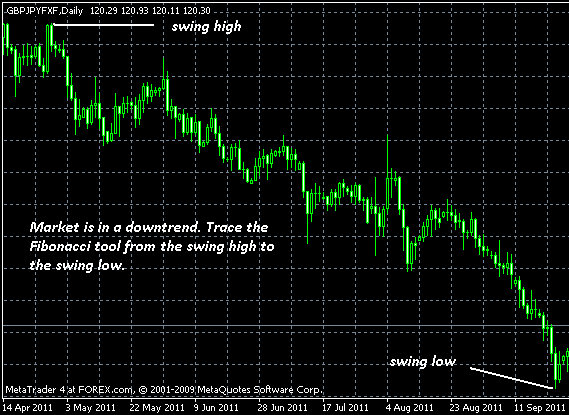
Identify the swing high and the swing low for the forex chart. The swing high is the highest point the price action has reached for the time period in view. The reverse is also true for the swing low.
Step 2.1
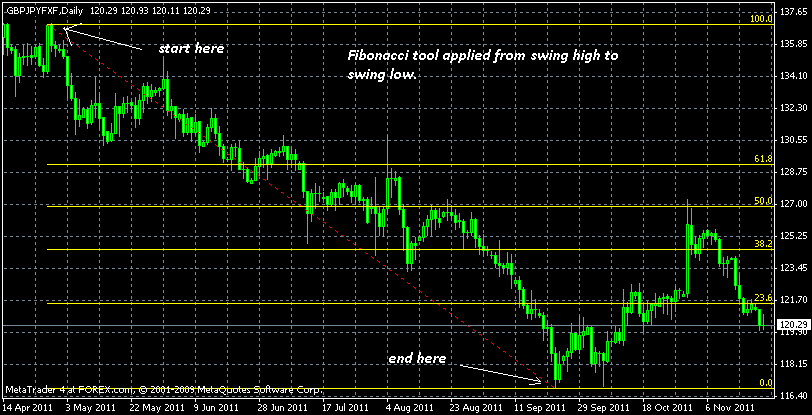
Select your Fibo tool, and if the market is in an uptrend, apply it to the swing low and trace the tool to the swing high. If the market is in a downtrend, apply the Fibonacci retracement tool from the swing high to the swing low.
Step 2.2
Step 3
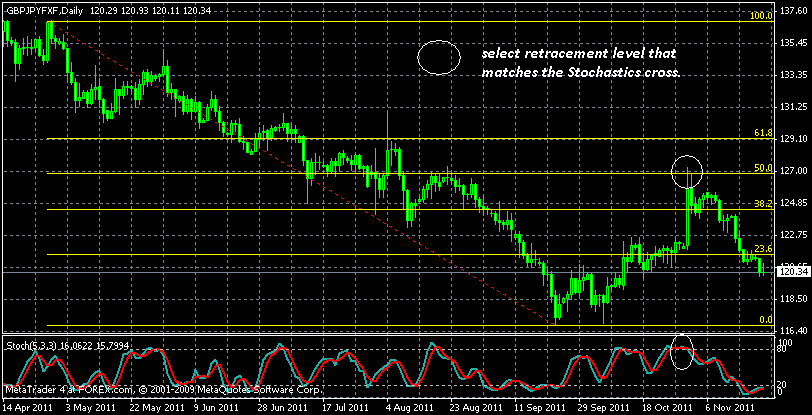
Apply a supporting technical indicator to the chart. The Stochastics oscillator, which detects overbought and oversold conditions and hence is perfect for detecting reversals, works very well here. Select the retracement level where the Stochastics cross at the oversold region for an uptrend (with downward retracement) or at the overbought region for a downtrend (with an upward retracement).
Step 3
Once you get the appropriate retracement level, it is time to take your trade in the direction of the main trend.
After reading this piece, you should be able to plot your Fibonacci retracement tool correctly so you can detect the appropriate level at which the retracement ends and a new round of buying begins.
Furthermore, do you need some extra Forex tools as a free trend detector? If so, click here for downloading free Forex tools from Pipburner. Respect the author and spread the word!

What You Should Be Doing When You Hit A Losing Streak Day Trading

Illustration: Money 

If you have traded the markets for any length of time you know that markets can and will change every so often. The problem with most trading systems is that they are designed for one type of market condition and that is it. As soon as conditions change, you are left with a system that under-performs. The great part about the NetPicks systems is that they are very flexible and can be adjusted to fit different market conditions. The Seven Summits Trader indicators give us access to so many different inputs that we can fine-tune our system should markets change. This gives us an incredible amount of power with our trading.

However, even with a dynamic system like the SST there will be times when we do need to make adjustments. For example, equity markets made a big change during the 4th quarter of 2011. We went from seeing nice movement to wild swings back and forth in both directions. This made it very difficult for my swing trading over the last few months of 2011. The good news is that I’m using the SST system, which gives me an edge over time. It is very important to trust this edge and to not over react to dips in performance over the short term.
The key to using such a dynamic system like the SST is to be very patient with change. Once you hit that first losing streak, it is going to be very tempting to want to throw everything out the window and start fresh with new settings or a new system all together. However, you need to make sure you are letting the edge that the system gives you play out over time. Even if you are winning 65% of the time that means the system is still losing 35% of the time. If you quit after a few losers you are going to miss out on tremendous profits in the end.
This is exactly why I like to track my performance on a daily basis. I take time everyday to log my trades and to take notes about that days performance. That way I know over time how my system is doing. Once you hit those few losing trades you can go and see that even with those losers the system is still very profitable over a larger sample of trades. This can help with the emotional aspect of trading. We have all been in that place where you get frustrated with the lack of profits. By having a trade journal you can go back and review the big picture.
When you do reach that point when it is time to make changes, what steps do you need to follow? Here are a few thoughts to keep in mind:
  • Make sure you are following all the rules of your system and trade plan correctly. If you are in a losing streak is it the system breaking down? Or is it just you making mistakes? I’ve been on both sides of this one myself over the years.
  • Review your trade journal to see an extended performance report. If you don’t document your trades on a daily basis, go back and record a few months worth. This way you can determine if it is a market change or just a pullback in performance.
  • Are there any small changes to your trade plan that you could make to help performance? For example, a change in start/end time or trading a different time of day. This will be much easier than starting over with a new market or even a new system.
  • Be slow to change. Your system won’t be profitable every day, week, or even month. If it is a proven system then give it time to get through a slow down. Many retail traders spend years and thousands of dollars going from one system to the next when all they need to do is master one system for the long haul.
  • If you do make changes to your system and trade plan make sure they are backed up by results and not just a hunch. We all tend to think we are smarter than we really are. Let the numbers speak for themselves. If you have an idea of a change that might improve performance, you better be able to back that up with test results.
Finally, make sure you are a consistent trader. This means you are taking the time to test your system before jumping in with both feet. Once you are trading live, make sure you keeping a daily trade journal. I know it is not fun stuff to do but it will pay off in a big way once you hit that first slowdown. Instead of beating your head against a wall trying to figure out what to do you will be able to calmly react accordingly based on numbers and a real performance report. The best traders I know are the ones that stay disciplined and committed to trading their system correctly over time. Always looking for the next best market or system will only lead to frustration and a loss of thousands of dollars.